

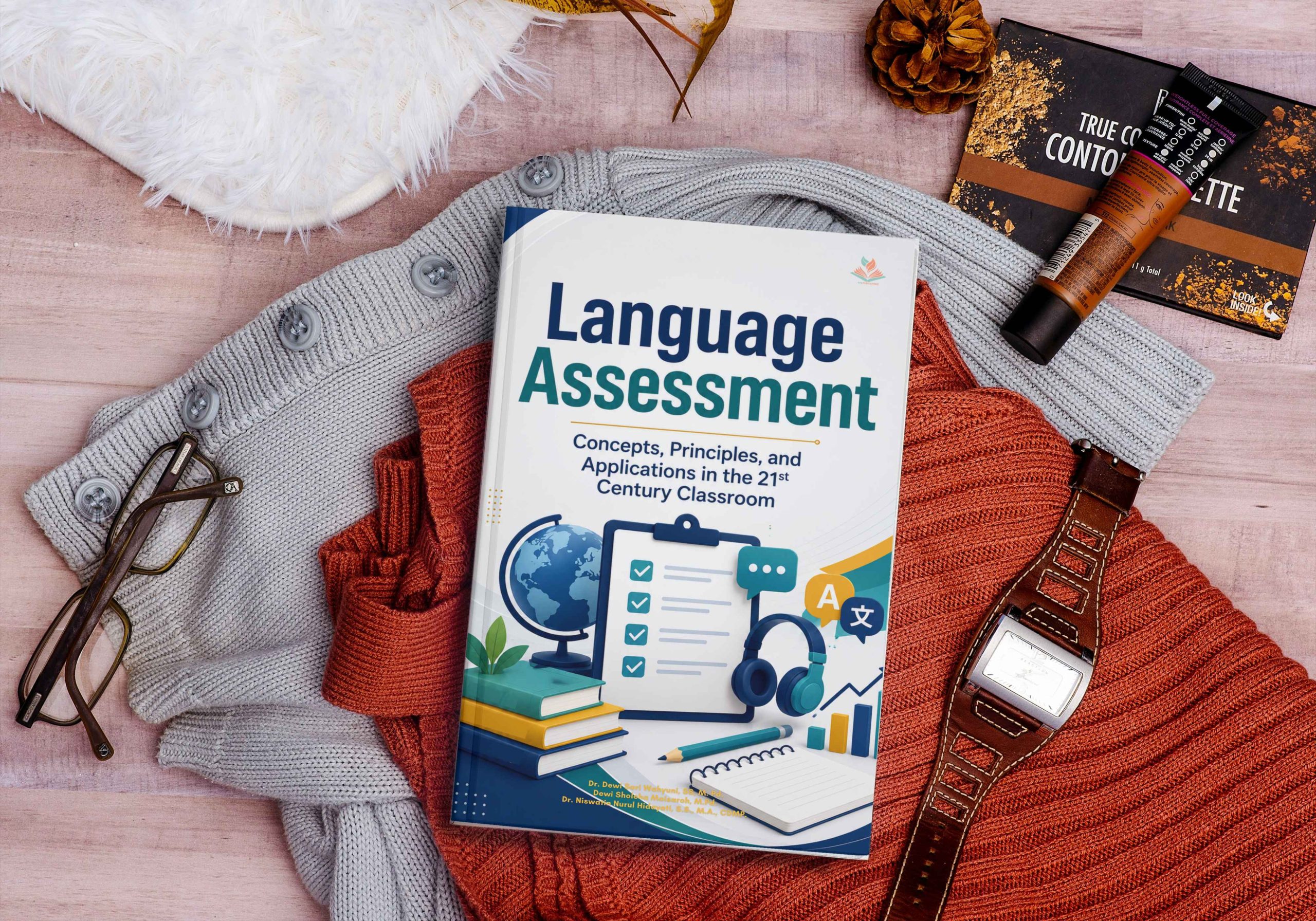

LANGUAGE ASSESSMENT Concepts, Principles, and Applications in the 21st Century Classroom
Description
- Authors : Dr. Dewi Sari Wahyuni, SS, M. Pd., Dewi Sholeha Maisaroh, M.Pd., Dr. Niswatin Nurul Hidayati, S.S., M.A., CDMP.
- ISBN :
- Copyright © September 2026
- Size: 15.5 x 23 cm
- Pages: 359
- Soft Cover
- Book Paper
- Synopsis: The book discusses essential concepts, principles, types, purposes, methods, and applications of language assessment while connecting established assessment theories with current developments in technology and digital learning. The book begins by introducing the fundamental concepts of language assessment, including assessment, testing, measurement, and evaluation, as well as the principles of validity, reliability, fairness, authenticity, and practicality. It then examines various purposes of assessment, including diagnostic, placement, formative, summative, achievement, and proficiency assessment. Particular attention is given to the assessment of the four major language skills—listening, speaking, reading, and writing—along with vocabulary and other important components of language ability.A central concern of this book is the development of effective and meaningful assessment practices. Assessment should not merely produce scores; it should generate useful evidence that supports instructional decisions and enhances student learning. For this reason, the book discusses assessment tasks, performance activities, rating scales, rubrics, test specifications, scoring procedures, and the interpretation of assessment results. It also emphasizes the importance of aligning assessment with learning outcomes and classroom instruction.
The 21st-century classroom presents new opportunities and challenges for language assessment. Digital platforms, online assessment, learning analytics, automated scoring, speech-recognition systems, and artificial intelligence are increasingly influencing how language learning is assessed. This book therefore considers the role of technology in assessment while maintaining critical attention to issues of validity, fairness, accessibility, privacy, transparency, and human judgment. Technology should enhance assessment rather than replace sound assessment principles. Another important focus is the changing role of learners and teachers. Contemporary assessment increasingly recognizes learners as active participants in the assessment process through self-assessment, peer assessment, reflection, portfolios, and formative feedback. Teachers, meanwhile, are expected not only to administer tests but also to design appropriate assessment tasks, interpret evidence, provide constructive feedback, and use assessment information to improve teaching and learning.
This book is intended for undergraduate and graduate students, teachers, prospective teachers, lecturers, researchers, and education practitioners who seek to develop their understanding and practice of language assessment. It can also serve as a reference for courses in language teaching, English language education, educational measurement, and assessment. The authors recognize that language assessment is a continually developing field. Changes in educational practices, digital technologies, artificial intelligence, language use, and learner needs will continue to influence assessment theory and practice. Therefore, this book does not present assessment as a fixed set of procedures but as a dynamic field that requires critical thinking, professional judgment, and continuous reflection.




Reviews
There are no reviews yet.