

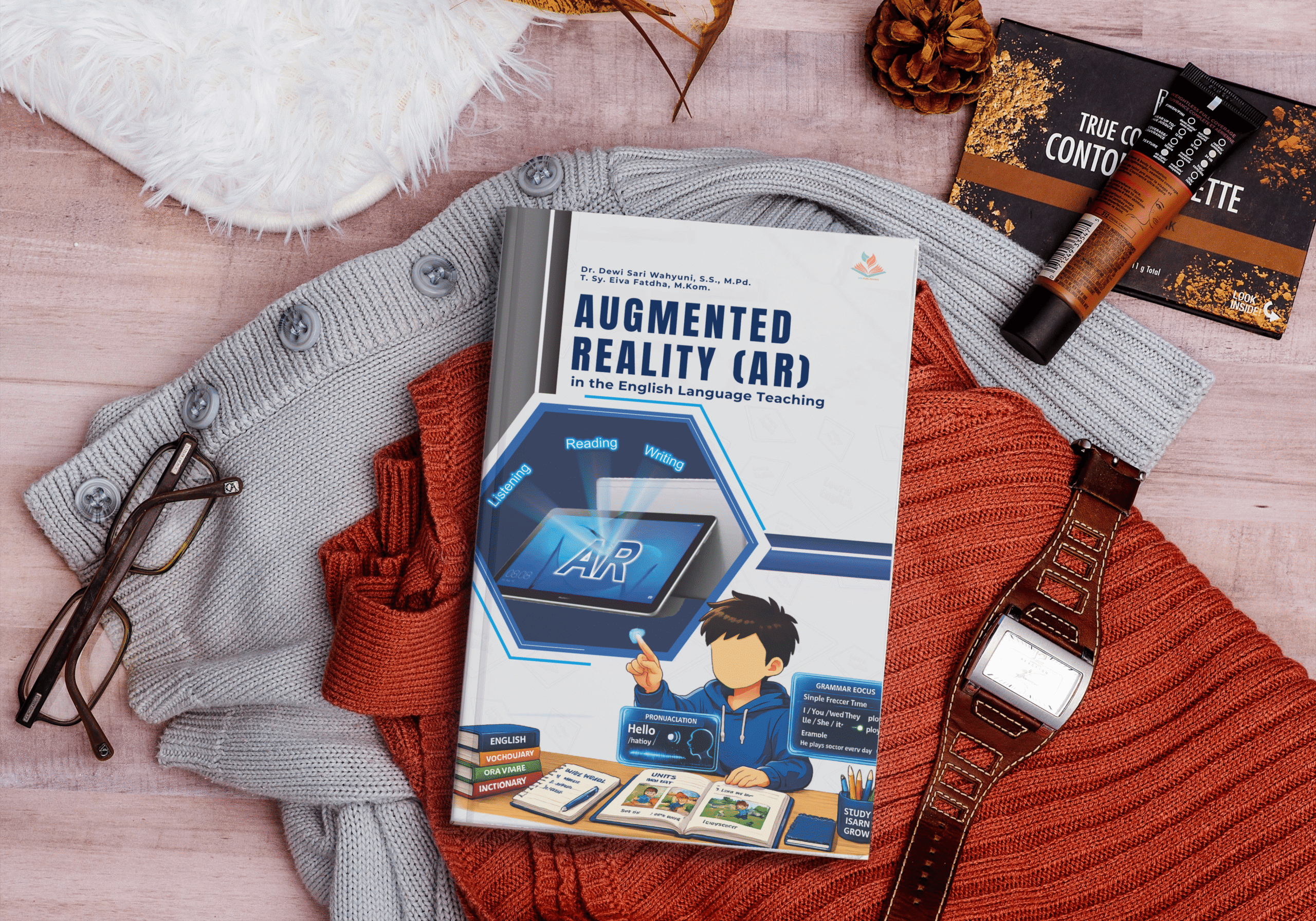


Augmented Reality (AR) in the English Language Teaching
Description
- Penulis : Dr. Dewi Sari Wahyuni, S.S., M.Pd., T. Sy. Eiva Fatdha, M.Kom.
- ISBN :
- Copyright © Juni 2026
- Ukuran: 15.5 x 23 cm
- Hal: 293
- Soft Cover
- Book Paper
- Sinopsis:The rapid advancement of digital technology has transformed nearly every aspect of human life, including education. In the field of language education, technological innovations have created new opportunities for teachers and learners to engage in more interactive, immersive, and meaningful learning experiences. Among these innovations, Augmented Reality (AR) has emerged as a promising educational technology that bridges the gap between the physical and digital worlds, enabling learners to interact with virtual content in real-time within authentic learning environments.
English language teaching in the twenty-first century requires approaches that not only develop linguistic competence but also foster learner engagement, creativity, critical thinking, and digital literacy. Traditional teaching methods, while still valuable, often face challenges in maintaining students’ motivation and addressing diverse learning needs. Augmented Reality offers a powerful solution by enriching learning materials with interactive visualizations, animations, audio elements, and contextual information that can make language learning more engaging and accessible. This book, Augmented Reality (AR) in English Language Teaching, has been written to provide a comprehensive understanding of the concepts, principles, applications, and future prospects of AR in English language education. It explores the theoretical foundations of AR, its pedagogical implications, practical classroom applications, instructional design considerations, and emerging trends in technology-enhanced language learning. In addition, the book discusses how AR can be utilized to support the development of listening, speaking, reading, writing, vocabulary, pronunciation, and communicative skills across different educational contexts.
The motivation behind this book stems from the growing need for educators, researchers, and students to understand how emerging technologies can be effectively integrated into language teaching and learning. As educational institutions continue to embrace digital transformation, teachers are expected not only to adopt technological tools but also to understand their pedagogical value and potential impact on student learning outcomes. This book seeks to serve as a bridge between theory and practice by providing both conceptual insights and practical examples of AR implementation in English language classrooms. Furthermore, this book highlights the opportunities and challenges associated with the adoption of Augmented Reality in education. While AR has significant potential to enhance learner engagement and facilitate experiential learning, its successful implementation requires careful planning, adequate technological infrastructure, teacher readiness, and pedagogically sound instructional design. Therefore, understanding both the benefits and limitations of AR is essential for maximizing its educational impact.
This book is intended for a wide audience, including pre-service and in-service teachers, teacher educators, researchers, graduate students, curriculum developers, and educational technology practitioners. It is our hope that this work will contribute to the growing body of knowledge on technology-enhanced language learning and inspire educators to explore innovative approaches that enrich English language teaching and learning.







Reviews
There are no reviews yet.